
What Is Commercial Plumbing? A Complete Guide for Property Owners
If you’ve ever wondered what is commercial plumbing and how it’s different from the work done in your home, you’re in the right place. The pipes, drains, and fixtures inside a single-family house share some DNA with the systems running through an office tower or a restaurant kitchen, but the similarities end quickly. Commercial plumbing operates on a different scale, under different rules, and with different consequences when something goes wrong. Whether you manage a retail property in Naperville, run a restaurant in Aurora, or oversee a school facility anywhere across Cook, DuPage, Kane, or Will counties, understanding what commercial plumbing actually involves helps you make smarter decisions about maintenance, repairs, and the professionals you trust with your building.
Table of Contents
- Understanding Commercial Plumbing: More Than Just Bigger Pipes
- Commercial vs. Residential Plumbing: Key Differences You Should Know
- Common Types of Commercial Plumbing Systems
- What Does a Commercial Plumber Actually Do?
- Commercial Plumbing vs. Industrial Plumbing: What’s the Difference?
- Why Commercial Plumbing Costs More (And Why It’s Worth It)
- Signs Your Commercial Property Needs Professional Plumbing Attention
- How to Choose the Right Commercial Plumbing Partner
Understanding Commercial Plumbing: More Than Just Bigger Pipes
Commercial plumbing covers the water supply, drainage, gas, and waste systems installed in buildings where people work, shop, eat, learn, and gather. Think office complexes, retail centers, hospitals, schools, restaurants, hotels, and large apartment buildings. These are not simply residential systems scaled up. They are engineered differently from the start to handle higher water pressure, greater daily volume, and usage patterns that would overwhelm a home plumbing network in hours.
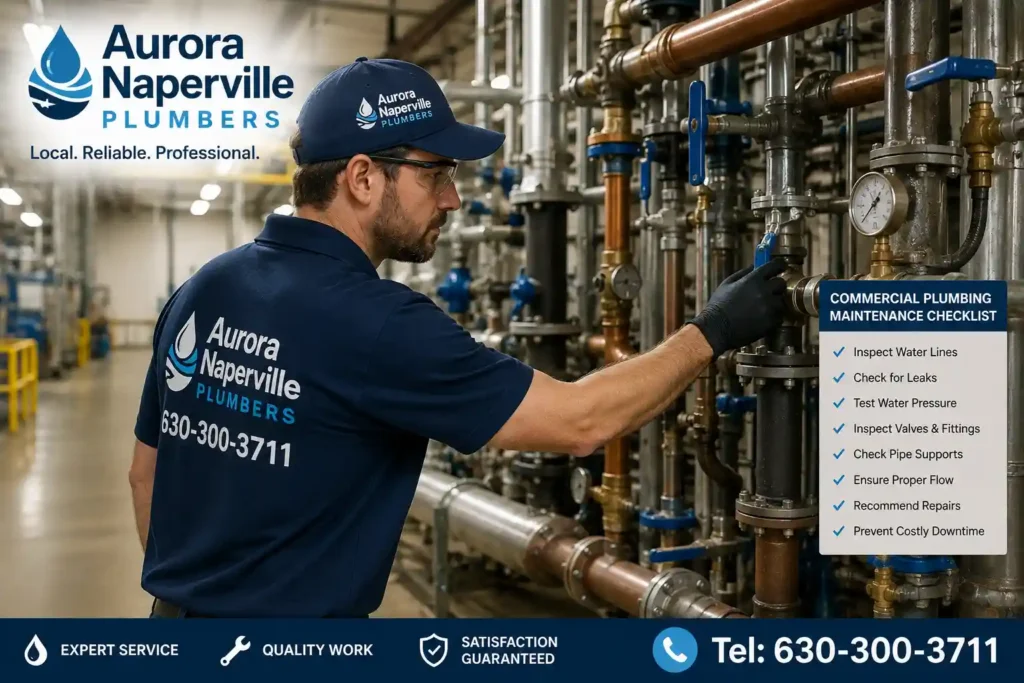
The components tell part of the story. Commercial systems rely on industrial-grade pipes made from copper, cast iron, or CPVC rather than the PVC and PEX common in residential construction. Backflow preventers are standard equipment, protecting municipal water supplies from contamination caused by pressure changes inside the building. Large-capacity water heaters, sometimes arranged in banks, serve hundreds of users simultaneously. Grease traps intercept fats, oils, and food solids before they enter sewer lines. Drainage networks include ejector pumps for below-grade fixtures and complex venting arrangements that keep everything flowing properly across multiple floors.
Building codes and health regulations add another layer. Commercial plumbing must satisfy stricter requirements than residential work, and the permitting process reflects that. A restaurant’s plumbing, for instance, has to meet health department standards that simply do not apply to a private home. The scale alone changes everything. A single commercial construction project might put dozens of plumbers, pipefitters, and welders on site at once, while a residential call typically involves one or two technicians in a van.
Commercial vs. Residential Plumbing: Key Differences You Should Know
System Complexity and Scale
Walk into a commercial building and you are standing above a network of plumbing that rivals the complexity of the structure itself. Multiple floors mean multiple wet walls, each carrying supply lines, drain stacks, and vent pipes that must coordinate perfectly with the floors above and below. A single restroom might have ten fixtures where a home bathroom has three. The water pressure has to remain consistent whether someone flushes on the first floor or the fifteenth, and the drainage system has to handle peak demand without backing up.
Residential plumbing is simpler by design. Fewer fixtures, lower water volume, and straightforward pipe layouts make diagnosis and repair faster. The materials reflect this difference. Homes commonly use PVC for drain lines and PEX for supply lines, both of which are cost-effective and easy to work with. Commercial projects lean on heavier-duty materials like cast iron for drainage and copper or CPVC for supply, chosen for durability and code compliance rather than ease of installation. Specialized equipment like backflow prevention devices, which protect against contaminated water flowing backward into the clean supply, appears in nearly every commercial building but is rarely needed in a single-family home.
Legal Requirements and Permits
The paperwork side of commercial plumbing deserves attention because it affects timelines and budgets in ways residential work does not. Commercial projects require more extensive permits, more rigorous inspections, and ongoing compliance obligations that continue long after the initial installation. Health department regulations apply to any facility that serves food, provides medical care, or houses vulnerable populations. Schools, hospitals, and restaurants all fall under specific plumbing codes that dictate everything from fixture counts to water temperature ranges.
Backflow prevention testing is often mandatory for commercial properties on an annual schedule, and failing to complete it can result in fines or water service interruptions. Residential plumbing permits, by comparison, are simpler to obtain and typically involve fewer agencies. The rules still matter, but the regulatory footprint is smaller.
Service and Maintenance Needs
Commercial properties cannot afford to treat plumbing maintenance as an afterthought. A restaurant with a clogged floor drain during dinner service loses revenue by the minute. An office building with no functioning restrooms sends tenants looking for new leases. The stakes are higher, and the speed of response matters differently than it does in a home where you can simply use a different bathroom until the plumber arrives.
Preventive maintenance programs become essential in commercial settings. Scheduled inspections catch small problems before they become emergencies that shut down business operations. Commercial water heaters and boilers need different expertise and follow different replacement timelines than residential units. When an emergency does happen, the response often involves coordinating with property managers, tenants, facility maintenance teams, and sometimes health inspectors. It is a more layered conversation than a homeowner calling about a leaky faucet.

Common Types of Commercial Plumbing Systems
Water Supply and Distribution Systems
Commercial buildings draw water from high-volume mains that feed into a network designed for heavy, simultaneous use across many fixtures. Pressure regulation becomes critical because municipal supply pressure that works fine for a two-story house might not reach the upper floors of a hotel without booster pumps. Backflow prevention sits at the entry point, protecting the public water supply from any contamination that could siphon backward during a pressure drop.
Hot water distribution in commercial settings often includes recirculation pumps that keep hot water moving through the pipes continuously. Without them, someone washing their hands on the far end of a hospital wing might wait minutes for warm water to arrive, wasting both water and time. Larger buildings frequently use zone-based systems that divide the structure into manageable sections, each with its own pressure regulation and isolation valves so that maintenance on one zone does not shut down the entire building.
Drainage and Waste Management
Commercial drainage systems move wastewater volumes that dwarf what any home produces. The pipe diameters are larger, the venting requirements are stricter, and the consequences of a blockage ripple outward faster. Grease traps are non-negotiable for restaurants and any food service operation. These devices capture fats, oils, and grease before they solidify inside sewer lines and create blockages that are expensive to clear and even more expensive to ignore.
Properties with below-grade bathrooms, laundry rooms, or kitchen facilities rely on ejector pumps to lift wastewater up to the sewer line elevation. When these pumps fail, the result is usually a basement flood that demands immediate attention. Sewer camera inspections have become standard practice for diagnosing commercial drainage issues. Rather than digging up pipe to find a problem, a technician runs a high-resolution camera through the line to pinpoint cracks, collapses, root intrusion, or grease buildup before they escalate into full-blown emergencies.
Gas Line Systems
Commercial gas lines supply more than just a furnace and a water heater. They feed kitchen equipment in restaurants, rooftop HVAC units in office buildings, backup generators in hospitals, and boiler systems in apartment complexes. The pressure ratings are higher, the pipe sizing is more exacting, and the safety requirements are more demanding than anything found in residential gas work.
Installation and repair must follow NFPA codes and local utility requirements, and the stakes of getting it wrong include fire, explosion, and carbon monoxide exposure. Gas line work in commercial settings demands specialized training and experience that goes well beyond what residential gas fitting requires.
What Does a Commercial Plumber Actually Do?
A commercial plumber installs, repairs, and maintains the plumbing systems in non-residential buildings. The work spans new construction projects where plumbers rough in pipe before the walls go up, tenant improvement jobs where existing spaces get reconfigured for new businesses, and emergency service calls where something has already failed and needs immediate attention.
A typical day might start with troubleshooting a backflow preventer at an elementary school, move to clearing a grease-clogged drain line at a restaurant, and finish with installing water heaters in an apartment building’s mechanical room. The variety is real, but so is the repetition. On large construction projects, a plumber might spend weeks running the same type of pipe across dozens of identical hotel bathrooms. The work requires reading blueprints, understanding mechanical plans, and coordinating with general contractors, electricians, and HVAC technicians who are all working in the same tight spaces on overlapping schedules.
The customer relationship differs from residential work in an important way. Residential plumbers work directly with homeowners, often in their kitchens and bathrooms, which demands a particular kind of interpersonal ease. Commercial plumbers typically interact with property managers, business owners, and facility maintenance teams. The conversations are more technical, the decisions involve more stakeholders, and the work is evaluated against a business’s bottom line rather than a family’s comfort.

Commercial Plumbing vs. Industrial Plumbing: What’s the Difference?
People sometimes use commercial and industrial plumbing interchangeably, but they describe different worlds. Industrial plumbing serves manufacturing plants, refineries, power generation facilities, and factories. These environments involve extreme temperatures, corrosive chemicals, high-pressure processes, and specialized materials like stainless steel or exotic alloys that you will never see in a shopping center or office building.
Commercial plumbing serves people conducting their daily business. Industrial plumbing serves heavy machinery and production processes. The pipe might carry acid in one setting and drinking water in the other. The licensing and training paths diverge as well. Industrial plumbers often hold additional certifications for welding, high-pressure systems, and hazardous material handling that commercial plumbers do not need.
For property owners and managers across Cook, DuPage, Kane, and Will counties, commercial plumbing is almost always the relevant category. Unless you operate a factory or processing plant, the plumber you call for a clogged drain or a failed water heater works in the commercial space. Industrial plumbing is a separate specialty with its own contractors, its own supply houses, and its own career path.
Why Commercial Plumbing Costs More (And Why It’s Worth It)
If you have compared quotes for commercial and residential plumbing work, you have noticed the difference. The higher cost reflects real factors, not arbitrary pricing. Materials alone account for a significant portion. Industrial-grade pipes, commercial fixtures, and specialized equipment like backflow preventers and grease traps cost substantially more than their residential counterparts. A commercial water heater is not just a bigger version of the one in your basement. It is engineered for continuous operation, higher recovery rates, and a service life measured in decades under heavy use.
Labor costs run higher because commercial projects demand larger crews with specialized expertise. The plumber working on your office building carries certifications and training that a residential technician might not need. Insurance and bonding requirements are more extensive for commercial contractors, and those costs get built into every job. Permitting and inspection fees add another layer that residential work rarely encounters at the same level.
The investment pays off in reliability. A properly designed and installed commercial plumbing system lasts longer, fails less often, and costs less to operate over its lifetime than a system built with shortcuts. When you factor in the cost of business interruption from a plumbing failure, the math tilts even further toward doing the work right the first time.
Signs Your Commercial Property Needs Professional Plumbing Attention
Plumbing problems in commercial buildings rarely announce themselves politely. They tend to escalate quietly until the damage is already underway. Knowing what to watch for helps you act before a nuisance becomes a crisis.
Frequent drain clogs or slow drainage across multiple fixtures often point to a deeper blockage in the main line rather than isolated sink or toilet issues. Unusual sounds from your pipes, including banging, whistling, or gurgling, suggest air in the lines, pressure problems, or partial obstructions that will only get worse. Water pressure fluctuations that affect multiple floors or zones indicate a supply-side issue that needs diagnosis.
Higher-than-normal water bills without an obvious cause almost always mean a leak somewhere in the system, possibly underground or inside a wall where you cannot see it. Visible leaks, water stains on ceilings or walls, and musty odors in basements or mechanical rooms are the signs you can spot directly. Irregular water heater performance, whether it is inconsistent hot water or strange noises coming from the tank, signals that the equipment needs professional attention before it fails completely.
How to Choose the Right Commercial Plumbing Partner
Finding a plumbing company that understands commercial work makes the difference between a quick resolution and a recurring headache. Start by looking for verifiable experience with properties similar to yours. A plumber who excels at residential service calls may not have the equipment or expertise to handle a restaurant’s grease trap or an office building’s backflow prevention system.
Verify licensing, insurance, and bonding specific to commercial work in your county. The requirements vary across Cook, DuPage, Kane, and Will counties, and you want a contractor who meets or exceeds them without exception. Ask about emergency response times before you need them. Commercial plumbing issues rarely happen during convenient hours, and a partner who can dispatch a technician within the hour at two in the morning is worth knowing.
Look for specialized capabilities like sewer camera inspection, hydro jetting, and backflow prevention testing. These are standard tools of commercial plumbing, and a company that offers them demonstrates that they serve commercial clients regularly, not occasionally. Read reviews from other commercial customers, not just residential homeowners. The experiences of property managers and business owners will tell you more about what to expect than a five-star rating from someone who had a kitchen faucet replaced.
A good commercial plumbing partner offers preventive maintenance programs that catch problems before they become emergencies. Regular inspections, scheduled drain cleaning, and water heater servicing keep your systems running and your tenants happy. The goal is a relationship that prevents calls, not just one that answers them.